Most “best AI tools” lists fail affiliate content operators the same way: they treat every tool as a standalone product and skip the question that actually matters — which tools fit together into a working system at your current stage?
This article takes a different approach. Instead of ranking tools in the abstract, it maps the categories that matter for affiliate content workflows, identifies what each category solves, and surfaces which tools fit which operators depending on how they work.
If you are still deciding where to start within the MoltyFlywheel system before picking tools, the Programs, Offers, and Tools decision guide covers that routing logic first.
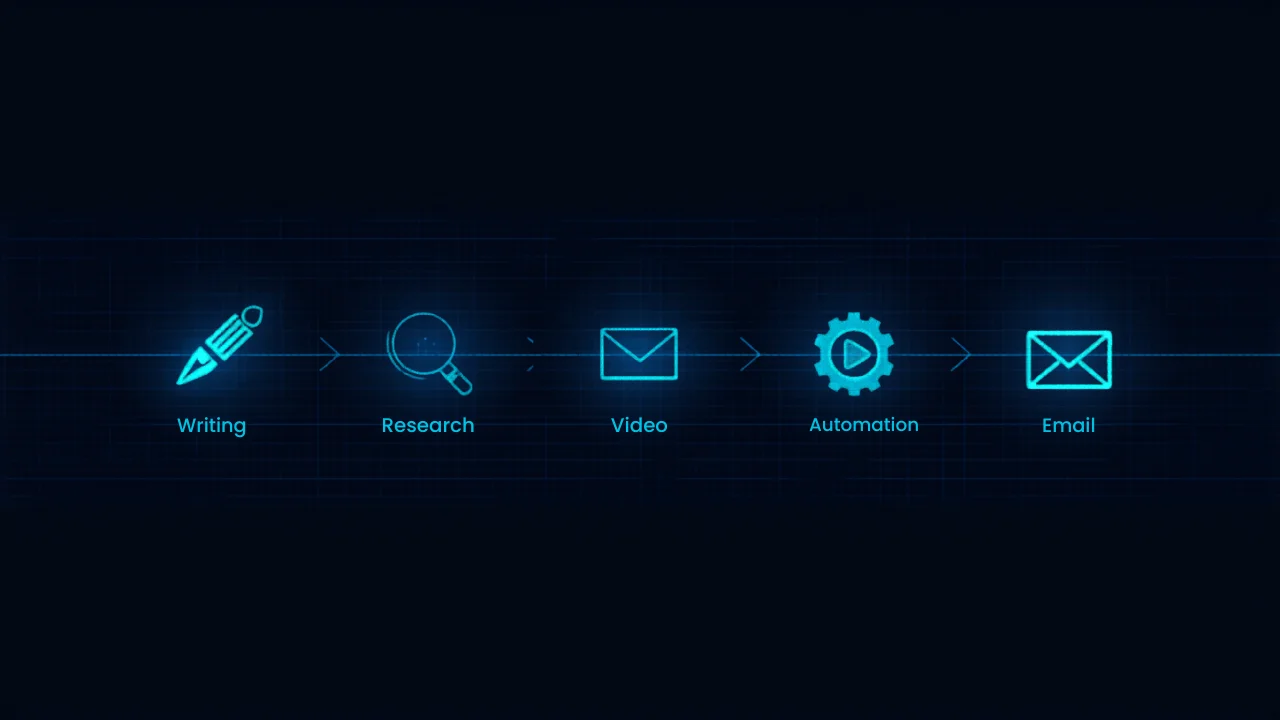
Quick Answer: For most affiliate content operators in 2026, a practical working stack covers five categories: writing, research, video or visual, automation, and email. The tools that matter most depend on your content format, output volume, and whether you are solo or working with a small team. Start with writing and research before adding anything else.
Why Tool Selection Fails for Affiliate Operators
The failure pattern is predictable.
Someone building an affiliate content operation looks at what successful operators use, copies the full stack, and ends up with five subscriptions they do not have time to learn before the billing hits.
The reason this happens is that tool categories get conflated:
- Writing tools solve the problem of content production
- Research tools solve the problem of source quality and topic coverage
- Video tools solve the problem of content format for audiences that prefer video or short-form visual
- Automation tools solve the problem of connecting workflows across platforms without manual steps
- Email tools solve the problem of owning the audience relationship instead of renting it from a platform
Each category solves a distinct problem. Adding a tool before you have the corresponding problem is waste.
Category 1 — Writing Tools
Writing tools are the core of any affiliate content operation. They are also the most overloaded category in terms of vendor claims.
What actually matters for affiliate content:
- Can the tool follow a clear structural brief without drifting into generic filler?
- Does it handle SEO-adjacent tasks like heading structure, answer-first formatting, and entity coverage?
- Can it help with comparison content, which is the format that drives most affiliate conversion?
Claude (Anthropic) is currently strong for affiliate content operators who want a capable general writing layer that can follow detailed briefs, handle structured comparisons, and produce output that does not read like a mass-generated template. It works best when you write clear prompts rather than expecting the tool to decide the content strategy for you.
Koala Writer is built specifically for affiliate SEO content, including Amazon affiliate workflows. If a significant portion of your operation is Amazon Associates or product review content, Koala Writer handles structured review formats more natively than a general-purpose model.
Which to start with: If you are building primarily for search and comparisons, Claude is the more flexible foundation. If you are working within a product review or Amazon affiliate format specifically, Koala Writer is worth evaluating first.
Category 2 — Research Tools
Most affiliate content problems are not writing problems — they are research problems.
A tool that can write quickly cannot fix a brief that lacks real information about the product, the audience intent, or the competitive landscape for the keyword.
Abacus AI (ChatLLM Teams) is useful here because it provides access to multiple leading models in a single subscription, which means you can use different models for different research tasks without maintaining separate accounts. If your workflow requires moving between research, reasoning, and drafting across a range of topics, a multi-model workspace reduces friction.
Perplexity is useful for fast, citation-linked research on topics where you need sources quickly. It works well as a first-pass research layer before moving to a writing tool.
Which to start with: If you are already using Claude for writing, the research layer can be added through Perplexity for web-grounded queries and Abacus AI if you want model access variety for more complex analytical tasks.
Category 3 — Video and Visual Tools
Video is not mandatory for affiliate content, but it becomes relevant at two points:
- When your target keywords have video-intent (searches where YouTube results appear prominently)
- When you are building content that supports paid ad creative alongside organic content
Topview AI is purpose-built for affiliate and ecommerce ad creative. Its reference-based video workflow — where you supply product URLs or reference footage — makes it practical for content operators who need product video or UGC-style creatives without building a full video production workflow from scratch. The Topview AI guide covers when this tool fits versus when it is overkill.
Higgsfield handles a different use case: cinematic and stylized video generation where the priority is visual quality over product specificity. It is less directly suited to affiliate product workflows but becomes relevant for operators building brand-level content or editorial video.
Which to start with: If you are building affiliate content for search primarily, video is not a first investment. If you are already building ad creative for paid channels, Topview AI fits the affiliate use case more directly than other video tools.
Category 4 — Automation Tools
Automation tools matter once you have a repeating workflow that is worth automating. They do not help before that point.
The threshold is usually: a task you do manually more than three times a week, involving more than one platform.
n8n and Make (formerly Integromat) are the two platforms that come up most frequently for lean affiliate content operations.
n8n is self-hostable and gives you more control over data handling, which matters for operators who work with sensitive lead data or want to avoid per-task execution costs at scale. Make is more approachable for operators who want visual workflow building without self-hosting complexity.
Both connect to most platforms an affiliate content operator would use: CMS tools, email platforms, social publishing tools, and analytics layers.
Which to start with: Neither is a priority until you have a repeating workflow that costs real time. If you have that workflow, Make is lower friction to start with. n8n becomes the better option as volume increases or if cost-per-execution becomes a concern.
Category 5 — Email Tools
Email is the audience ownership layer. Unlike traffic from search or social, an email list does not depend on algorithm changes or platform policy shifts.
For affiliate content operators, the core question is not which email tool has the most features — it is which tool is cleanest for solo or small-team operation with a content-first newsletter model.
ConvertKit (now Kit) is built for the creator and content operator use case. Its segmentation and automation is functional without being complex, and its affiliate program is notable within the creator space.
Beehiiv has positioned itself around newsletter growth and monetization, with built-in ad network access and growth features that are more directly useful for operators building a newsletter as a primary distribution layer.
Which to start with: If email is a secondary distribution channel that supports your SEO content, ConvertKit is the more straightforward setup. If you are building a newsletter as the primary product and want monetization and growth tools baked in, Beehiiv is worth evaluating.
Matching the Stack to Your Stage
The most common mistake is not choosing the wrong tool — it is adding tools before the corresponding problem is real.
A practical sequencing for most affiliate content operators:
Stage 1 — Content output problem: Start with a writing tool only. Claude or Koala Writer depending on content format. Add a research layer (Perplexity) when source quality becomes the constraint.
Stage 2 — Audience ownership problem: Add email once you have consistent content output and a reason for someone to subscribe. ConvertKit or Beehiiv depending on your newsletter model.
Stage 3 — Workflow repetition problem: Add automation once a specific workflow costs you real time more than three times a week. Make or n8n depending on volume and self-hosting preference.
Stage 4 — Format expansion problem: Add video or visual tools only when video-intent keywords or ad creative become a real part of the operation. Topview AI for affiliate ad creative, Higgsfield for stylized brand content.
If you want to match specific tools to your workflow type before building the stack, the Affiliate Tools for Content Creators offer page covers that decision logic in more detail.
What to Avoid
A few patterns that reliably waste time and budget:
Buying a video tool before you have a content volume problem. Video adds surface area and production cost. It is not a replacement for a working written content system.
Running multiple general-purpose AI writing subscriptions. If you are paying for Claude, ChatGPT, and Gemini simultaneously for writing, you are not using any of them at the depth that justifies the cost. Pick one for production and use the others for spot testing.
Adding automation before you have a repeating workflow. Automation tools require setup time. That setup only pays off if the workflow runs frequently enough to justify it.
Treating email as an afterthought until the list is large. The optimal time to start an email list for an affiliate content operator is early. The content you build anyway can seed the newsletter. Waiting until you have a large audience to “do email properly” is a common delay that compounds.
Frequently Asked Questions
What is the minimum viable AI tool stack for an affiliate content operator?
A writing tool and a research layer. In practice, that is often Claude plus Perplexity, or Koala Writer for more structured product review content. Everything else is added based on specific workflow needs, not because the tool is popular.
Is it worth paying for multiple AI writing subscriptions?
Not usually. A single capable writing tool used well outperforms splitting attention across several. The exception is if different tools genuinely handle different content types in your workflow — for example, Claude for editorial comparison content and Koala Writer for structured Amazon review formats.
Do I need a video tool to run an affiliate content operation in 2026?
No. Video adds value in specific contexts: video-intent keywords, paid ad creative, and format diversity for audiences that engage with video. If none of those apply to your current operation, a video tool is not a priority.
When should I add automation to my affiliate workflow?
When you have a specific repeating task that involves more than one platform and costs you real time at least three times per week. Before that point, the setup cost of automation tools exceeds the return.
ConvertKit or Beehiiv for affiliate content newsletters?
If your newsletter is a secondary distribution channel for SEO content, ConvertKit is lower friction. If you are building the newsletter as the primary product with growth and monetization as core goals, Beehiiv is worth the evaluation.
Which Tools Actually Fit Your Workflow?
Not every tool on this list belongs in every affiliate content stack.
The Affiliate Tools for Content Creators page maps tools to specific workflow types so you can see which combination fits your current stage without trialing everything at once.
It helps you:
- Match tools to your content format and output stage
- Avoid adding tools before the corresponding problem is real
- Build a stack that holds together instead of one that fragments your attention