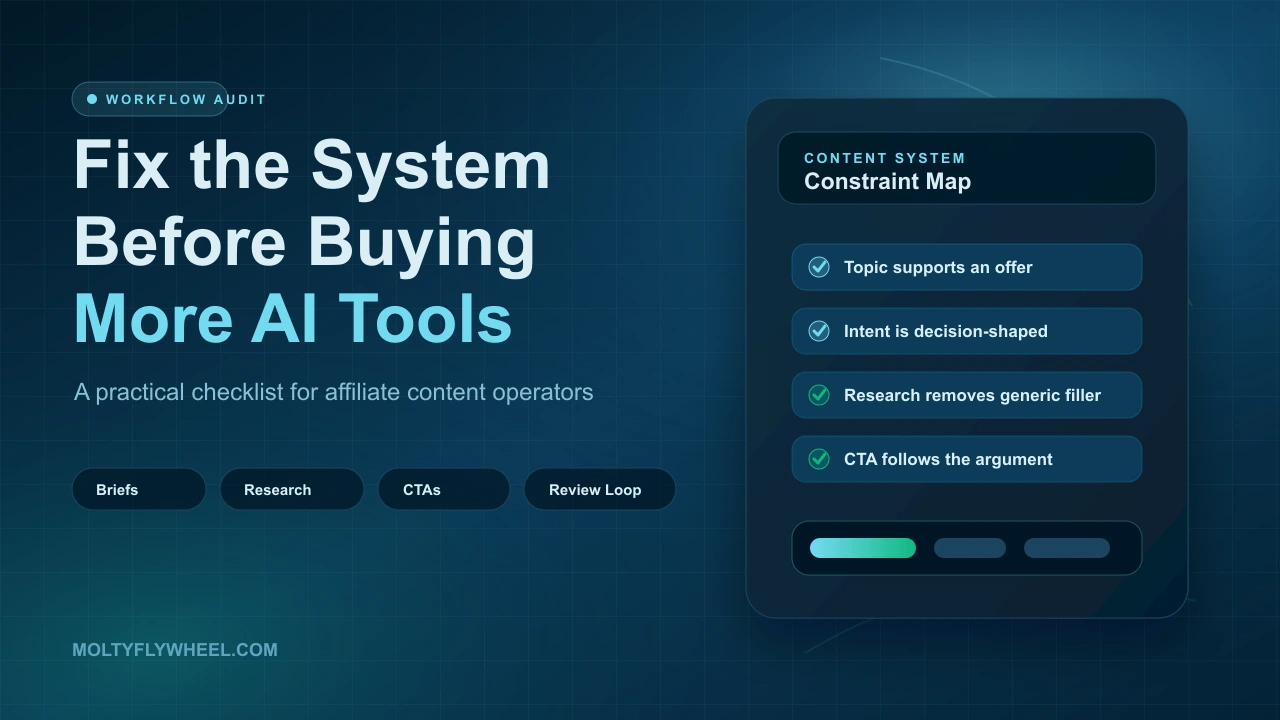
Most AI content problems do not come from using the wrong tool.
They come from using good tools inside a weak workflow.
That difference matters because the usual response is expensive. A content operator gets inconsistent drafts, weak rankings, low affiliate clicks, or messy publishing handoffs, then assumes the fix is another AI subscription. The stack grows, the workflow gets heavier, and the output does not improve enough to justify the added complexity.
An AI content workflow audit is the opposite move. Before you buy another tool, you inspect the system already producing your content: the brief, research, drafting, editing, internal links, CTA placement, publishing, and review loop.
Quick Answer: Run an AI content workflow audit before adding another tool when your content output feels inconsistent, slow, generic, or hard to publish. The audit should identify which step is actually failing: topic selection, research depth, prompt quality, editing standards, affiliate offer fit, publishing friction, or performance review. Add a new tool only after you know which constraint it solves.
If you are still choosing the broader stack, start with the best AI tools for affiliate content workflows. This article assumes you already have some tools and need to make the system work better.
Why AI Content Workflows Break
AI makes content production faster, but it also makes weak systems more visible.
If your brief is vague, AI creates vague content faster. If your affiliate offer does not match the search intent, AI writes a smoother version of the wrong recommendation. If nobody reviews internal links, the article may read well but fail to move visitors toward useful pages.
The common failure pattern looks like this:
- You collect topics from keyword tools or competitor pages.
- You ask an AI tool to write the article.
- The draft looks acceptable at first glance.
- Editing takes longer than expected because the article lacks point of view.
- Affiliate links are added near the end instead of being built into the argument.
- The post goes live, but it does not earn clicks or rankings.
- You assume the next tool will fix the system.
The tool may not be the problem. The workflow may be missing the decisions that make the tool useful.
The Audit Principle: Find the Constraint First
A good workflow audit starts with one question:
Where does quality actually break?
Do not audit every part of the system with equal intensity. Look for the constraint that limits the whole output.
For affiliate content operators, constraints usually sit in one of seven places:
- Topic selection
- Search intent matching
- Research quality
- Draft structure
- Editorial review
- Affiliate offer fit
- Publishing and performance review
Each constraint produces a different symptom. Generic posts usually point to weak research or weak prompts. Posts with traffic but no clicks usually point to offer fit or CTA placement. Slow publishing usually points to editing, formatting, or CMS handoff friction.
Buying a tool without naming the constraint is guesswork.
Step 1: Audit Topic Selection
Topic selection is where many AI content workflows quietly fail.
The problem is not that the topic is bad in isolation. The problem is that the topic may not support the business model.
For MoltyFlywheel-style affiliate content, a good topic usually has at least one of these qualities:
- It helps a reader choose between tools.
- It explains a tool category with commercial intent nearby.
- It supports an offer page, program page, or comparison page.
- It answers a practical workflow question that can naturally lead to a tool recommendation.
- It strengthens a cluster where the site already has authority.
A weak topic may still get impressions, but it does not create a useful next step.
During the audit, pick the last ten published or drafted posts and ask:
- What offer or internal page should this post support?
- What reader problem does the post solve?
- Is the reader likely to need a tool after reading it?
- Does the post belong to an existing cluster?
- Would this topic still be worth publishing if it never ranked for a head keyword?
If those answers are unclear, your topic workflow needs repair before your writing workflow.
Step 2: Audit Search Intent
AI tools can follow a brief, but they cannot rescue a brief that misunderstands intent.
Search intent is not just informational, commercial, transactional, or navigational. For affiliate content, the more useful question is:
What decision is the reader trying to make?
For example, someone searching “best AI writing tool for affiliate blogs” is not asking for a generic explanation of AI writing. They are trying to decide which tool fits an affiliate publishing workflow. A post that spends too long explaining what AI writing is will feel slow, even if the writing is polished.
Audit each article brief for the intended decision:
- choosing a tool
- understanding a category
- comparing two options
- fixing a workflow problem
- deciding whether a tool is worth paying for
- sequencing which tool to add next
Then inspect the article intro and headings. If they do not immediately reflect that decision, the post is likely drifting.
A strong AI workflow should make intent explicit before drafting starts. Otherwise, the model fills space with plausible background information.
Step 3: Audit Research Quality
Most AI content that feels generic is under-researched.
The model may write fluent paragraphs, but it cannot create a sharp operating point of view from a thin brief. This is especially true for affiliate content because readers need specifics: where the tool fits, where it does not fit, what workflow it supports, and what tradeoffs matter.
Your research layer should answer practical questions before writing:
- What is the reader already trying?
- What are the competing tools or approaches?
- What claims are vendors making?
- What objections would a skeptical buyer have?
- What internal pages should the article connect to?
- What examples would make the advice concrete?
If your current system only gives the AI model a keyword and a title, the draft will probably be shallow.
This is where tools can help, but only after the workflow is clear. A research layer like Perplexity or a multi-model workspace like Abacus AI can improve coverage, but the operator still needs to decide what evidence matters.
The audit test is simple: open a recent draft and highlight every paragraph that could appear on any competitor site with only the brand names changed. Those paragraphs usually indicate missing research, missing examples, or missing editorial judgment.
Step 4: Audit the Draft Structure
AI drafts often fail because the structure is too article-shaped and not decision-shaped.
A useful affiliate guide should move the reader through a decision path:
- Define the problem clearly.
- Explain the decision criteria.
- Compare the realistic options.
- Recommend what to do based on stage or use case.
- Point to the next useful page, tool, or offer.
That is different from a generic SEO outline.
During the audit, scan the headings of each recent article without reading the body. The heading stack should tell a coherent story by itself.
Weak heading stacks usually look like:
- What is X?
- Why X matters
- Benefits of X
- How to use X
- Conclusion
That outline can work for a beginner explainer, but it is not enough for most affiliate posts. A stronger outline names the actual decision:
- When X is the right layer
- Where X breaks down
- What to compare before paying
- Which workflow should use X first
- What to add next after X
If your AI drafts are consistently bland, fix the outline template before changing models.
Step 5: Audit Editorial Review
The fastest way to improve AI content is to stop editing only for grammar.
Grammar is rarely the main problem. The main problems are usually:
- vague claims
- unsupported comparisons
- repeated ideas
- weak examples
- unclear recommendations
- CTAs that feel bolted on
- internal links that do not match the reader’s next step
A practical editorial review pass should check the article as a business asset, not just as text.
Use this review sequence:
Clarity pass: Does the post make one clear promise and keep it?
Specificity pass: Are there examples, use cases, and concrete tradeoffs?
Conversion pass: Does the affiliate recommendation appear where it naturally belongs?
Internal link pass: Does the post guide readers to the next relevant page?
Risk pass: Are there claims that need evidence, softening, or removal?
If your team cannot review every post deeply, create a lighter checklist for low-risk posts and a deeper checklist for comparison, review, and high-intent articles.
Step 6: Audit Affiliate Offer Fit
Affiliate links do not convert because they exist. They convert because the article has made the tool feel like the next logical step.
This is where many AI workflows underperform. The article may recommend a tool, but the recommendation is not connected to the reader’s problem.
Audit each affiliate placement with three questions:
- What problem did the article just prove the reader has?
- Why is this specific tool a reasonable next step?
- Is there a more relevant internal page before the affiliate click?
Sometimes the best next step is not an affiliate link. It may be a comparison page, a program review, an offer page, or a beginner guide.
For example, if a post explains that the reader needs a writing and research layer, a direct CTA to Claude can make sense. If the post is still helping the reader choose between several categories, an internal link to a tool stack guide may be better.
The audit goal is not more links. It is cleaner intent matching.
Step 7: Audit Publishing and Performance Review
The content workflow does not end when the article goes live.
Publishing creates the first version of the asset. Performance review improves the system that created it.
A lightweight review loop should track:
- which posts were published
- which cluster each post supports
- what offer or page each post points to
- whether the article was indexed
- whether the post earns impressions
- whether readers click internal or affiliate links
- which titles and topics create the most useful traffic
You do not need a complex dashboard at the beginning. A simple spreadsheet is enough if it creates better decisions.
The key is to feed learning back into the workflow. If comparison posts earn more clicks than broad guides, publish more comparison-led content. If beginner tutorials get traffic but no affiliate clicks, use them to support email capture or internal navigation instead of forcing direct monetization.
Without a review loop, the AI system keeps producing content without learning from the market.
When a New Tool Actually Makes Sense
After the audit, a new tool may be the right move. The difference is that you now know why.
Add a writing tool when draft quality is the constraint and your current model cannot follow the structure you need.
Add a research tool when drafts are fluent but shallow.
Add an automation tool when publishing or formatting requires repeated manual work.
Add a hosted agent platform when multiple workflow steps need to run together with memory, scheduling, file handling, or tool execution.
Add a video or visual tool when the content format genuinely requires it, not because visual AI is interesting.
This is the better sequence:
- Name the constraint.
- Fix the process if process is enough.
- Add a tool only if the process needs capability you do not currently have.
- Measure whether the constraint improved.
That sequence keeps the stack smaller and the output stronger.
A Simple 30-Minute Audit
If you want a fast version, run this once a week.
Pick three posts: one that performed well, one that underperformed, and one that is still in draft.
For each post, answer:
- What decision is the reader trying to make?
- What offer or internal page does this post support?
- Where does the article become generic?
- Which section would a skeptical reader challenge?
- Is the CTA a natural continuation of the argument?
- What should be changed in the next brief because of this post?
Then update the workflow, not just the article.
That last point is the compounding move. Editing one article improves one article. Editing the workflow improves every article after it.
Recommended Starting Stack
For a lean affiliate content operation, the minimum viable stack is still simple:
- Claude for structured drafting, editing, and outline refinement
- A research layer for source quality and competitive context
- A publishing checklist for frontmatter, internal links, CTAs, and image assets
- A performance tracker for learning what topics and offer paths work
Only add automation after the same manual step repeats enough to become a real cost. At that point, tools like n8n or Make can help move briefs, drafts, publishing tasks, and reporting steps between systems.
If the workflow becomes too fragmented, a hosted agent platform may be worth evaluating. Use the hosted agent platform checklist before replacing your current setup.
Bottom Line
An AI content workflow audit is not glamorous, but it protects the operator from the most common AI tool trap: confusing more capability with better output.
Better output usually comes from a cleaner system.
Before you add another subscription, inspect the workflow that turns ideas into published assets. Find the step that creates generic writing, weak recommendations, slow handoffs, or poor conversion. Fix that constraint first.
Then, if a tool still makes sense, you will know exactly what job it needs to do.
Start with Claude Pro if your main constraint is structured drafting and editorial refinement. Add workflow automation only when the process itself is clear enough to automate.