If you evaluate a hosted agent platform only by the demo, you will probably overestimate what it can replace.
The real question is narrower: can the platform take over enough of your current workflow stack to reduce operational drag without weakening control, visibility, or output quality?
Quick Answer: A hosted agent platform is worth replacing your current stack only when it improves the full operating loop: model access, tool execution, scheduling, memory, permissions, observability, and human review. Do not switch because the agent looks impressive in isolation. Switch when the hosted layer removes work your team is already doing badly, manually, or inconsistently.
For the closest comparison in this cluster, start with the Abacus AI vs OpenClaw managed agent comparison. This article is the next layer: the evaluation checklist you should run before replacing anything.
What a hosted agent platform actually has to replace
A hosted agent platform is not just a chatbot with better tools.
If you are considering a replacement, the platform is competing with your current operating system for AI work. That may include separate model subscriptions, browser automation, code execution, scheduled jobs, document workflows, spreadsheet steps, internal SOPs, and manual review loops.
That is why the evaluation should start with the stack you already have, not with the vendor’s feature list.
Map the current system first:
- which tasks happen every day or every week
- which tools each task touches
- where context is stored
- who approves outputs before they go live
- what breaks most often
- which steps are slow because humans are copying data between tools
Only then should you ask whether the hosted platform can replace the stack.
The wrong evaluation question is, “Can this agent do impressive work?”
The better question is, “Can this agent run our actual workflow with less coordination cost than the current setup?”
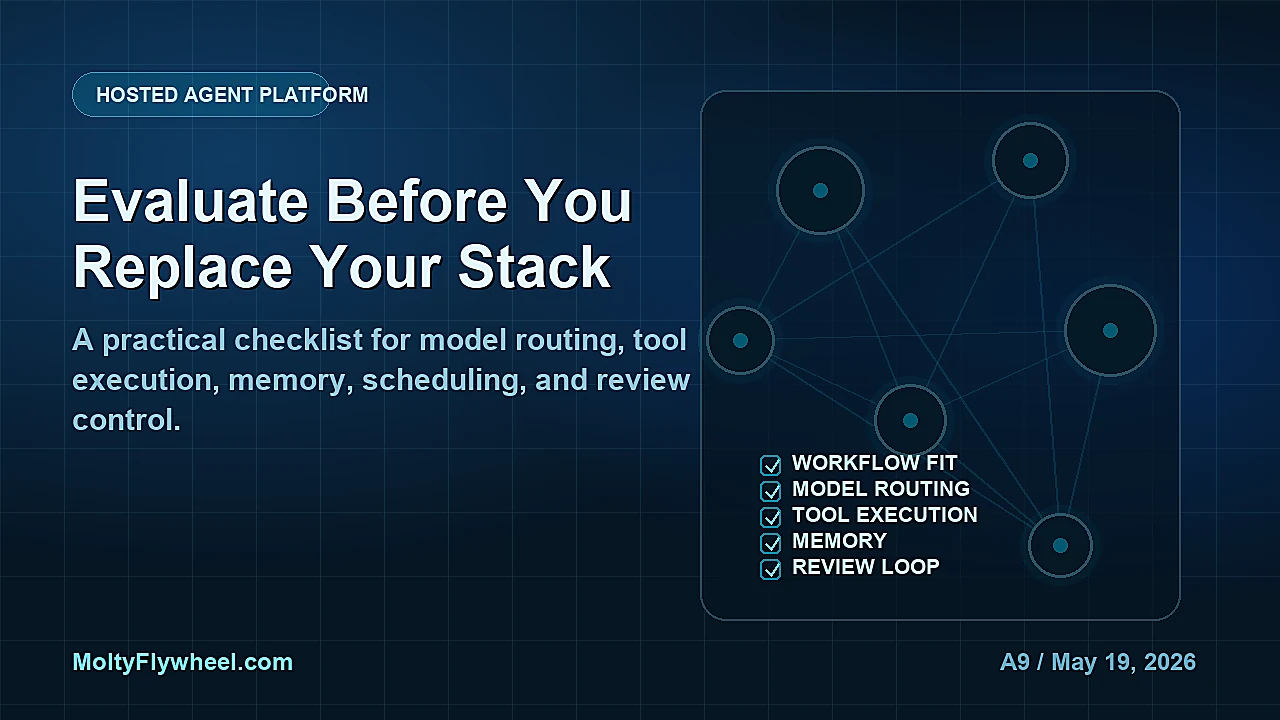
The seven evaluation dimensions
Use these seven dimensions before you commit to a hosted agent platform. A platform does not need to win every category, but it should be strong in the categories that matter for your workflow.
1. Workflow fit
Workflow fit is the first filter.
The platform should support the actual shape of your work: research, writing, code changes, report generation, data cleanup, creative briefs, recurring checks, or tool-connected operations.
Do not evaluate only the cleanest demo path. Evaluate the messy path:
- a vague input that needs clarification
- a task that spans multiple tools
- a recurring job with slightly different inputs each time
- an output that needs review before publishing
- a failed run that needs diagnosis
If the platform only works when the task is perfectly scoped, it may still be useful. But it is not replacing much of your stack.
2. Model routing
Most agent platforms talk about intelligence. The more practical issue is routing.
Your workflow may need different model strengths for different steps: research synthesis, code reasoning, fast drafts, structured extraction, image ideation, or editorial critique. A hosted agent platform becomes more valuable when it lets you route tasks without constantly moving context between separate products.
This is where a multi-model layer can matter. The Abacus AI model stack guide explains the broader routing logic: multi-model access helps when task type determines model choice, not when the team simply wants more options to test.
During evaluation, ask:
- Can you set reasonable defaults?
- Can you choose stronger models for harder steps?
- Does the platform preserve context across model changes?
- Can non-technical users understand which model or mode they are using?
If model routing creates more decisions than it removes, it becomes noise.
3. Tool execution
Agent value depends on execution, not just reasoning.
A hosted platform should be able to take action in the places where your work actually happens. That may mean browser use, file handling, code execution, spreadsheet updates, calendar checks, document generation, app integrations, or web research.
The important test is not whether the platform has a long integrations page. It is whether the agent can complete the specific sequence your team needs.
Use one real workflow as the test case. For example:
- Read a short brief.
- Gather supporting context.
- Produce a structured draft.
- Save the output in the right format.
- Flag uncertainties.
- Wait for approval before the final action.
If the platform cannot complete that loop reliably, it is not ready to replace the workflow. It may still be useful as an assistant inside the workflow.
4. Memory and context control
Memory is useful only when it is governed.
A hosted agent platform should make it clear what the agent remembers, where persistent context lives, and how stale context is corrected. Otherwise, memory becomes another hidden source of drift.
For content and affiliate operations, this matters because the same agent may touch brand rules, tool positioning, internal links, CTA rules, and publishing workflows. If the agent remembers the wrong instruction, it can repeat that mistake across many outputs.
Evaluate memory with practical questions:
- Can you separate project context from personal context?
- Can you update or remove outdated instructions?
- Can the agent cite which context it used?
- Can different workflows have different operating rules?
- Can sensitive data be excluded from persistence?
Good memory reduces repeated instruction. Bad memory makes mistakes persistent.
5. Scheduling and background work
Replacing a stack usually means replacing recurring work, not only one-off chat sessions.
If your current system uses cron jobs, content calendars, weekly reports, queue checks, or monitoring tasks, the hosted platform needs a credible background-work layer.
This is one reason managed Claw-style platforms are interesting. Persistent agents with scheduling can handle routine work that would otherwise require a custom setup. But scheduled work also raises the bar for safety.
Before using background agents, define:
- what triggers the run
- what the agent is allowed to change
- what must stay draft-only
- when a human must review
- how failures are reported
- how duplicate runs are prevented
If those rules are not clear, automation will create cleanup work instead of leverage.
Where hosted platforms usually help
Hosted agent platforms tend to help most when the current stack is fragmented.
That usually looks like this:
- one tool for chat
- another tool for coding
- another tool for browser automation
- another tool for scheduling
- separate files for instructions
- manual copy-paste between each step
- no consistent audit trail
In that environment, a hosted agent platform can reduce coordination cost. The value is not that every individual feature is unique. The value is that the workflow happens in fewer places.
This is especially relevant for small operator teams. They often do not have the time to maintain custom infrastructure, but they still need repeatable systems for content, research, reporting, and tool evaluation.
For a broader stack view, the AI tools for affiliate content workflows guide shows how writing tools, SEO tools, automation layers, and agent systems fit together before you decide what to consolidate.
Where hosted platforms are less ideal
A hosted agent platform is less ideal when your current stack is already clear, stable, and well-owned.
If your team has strong internal tooling, clean automations, predictable model routing, and a working review process, switching platforms may introduce migration overhead without enough upside.
Be especially cautious when:
- the platform cannot support one critical integration
- your data governance requirements are strict
- you need full control over storage and execution
- your workflows are highly custom
- your team already has a reliable self-managed environment
Hosted convenience is valuable, but convenience is not the same as fit.
There is also a learning-curve cost. A platform that promises to simplify your stack can still require new habits, new permissions, new review rules, and new failure handling.
A practical replacement checklist
Before replacing your current stack, run a two-week evaluation using real work.
Do not use a synthetic demo task. Use a workflow that currently creates friction.
Week 1: mirror the workflow
Run the hosted agent platform beside your current process.
The goal is comparison, not migration.
Track:
- setup time
- number of manual handoffs
- output quality
- review time
- error rate
- missed context
- required human correction
If the hosted platform cannot match the current process in a mirrored test, it is not ready to replace it.
Week 2: let it own a narrow slice
Give the platform one bounded workflow that is useful but low-risk.
Good candidates include:
- weekly research summaries
- draft outline generation
- internal brief preparation
- content QA checks
- source monitoring
- simple reporting workflows
Avoid starting with final publishing, production code changes, customer communication, or financial operations unless the review layer is extremely clear.
Final decision
After two weeks, ask one question:
Did the platform reduce the work required to produce a reliable outcome?
If yes, expand slowly.
If no, keep it as an assistant or remove it from the stack.
The goal is not to adopt agent infrastructure for its own sake. The goal is to make the operating system smaller, clearer, and easier to run.
Frequently Asked Questions
What is a hosted agent platform?
A hosted agent platform is a managed environment where AI agents can use tools, retain context, run workflows, and sometimes execute scheduled tasks without you maintaining the infrastructure yourself. It differs from a normal chatbot because it is designed around multi-step work, not only conversation.
When should I replace my current AI workflow stack?
Replace it only when the hosted platform handles real workflows with less coordination cost, fewer manual handoffs, and acceptable review control. If the current stack is stable and the hosted tool only adds another interface, do not replace it yet.
Is Abacus AI a hosted agent platform?
Abacus AI is positioned as a broader AI workspace that includes model access, agent capabilities, and Abacus Claw as a hosted OpenClaw-style path. For MoltyFlywheel readers, the relevant question is whether that managed layer fits your workflow better than maintaining separate tools or a self-managed agent setup.
Should solo operators use hosted agents instead of self-hosting?
Usually, yes for early evaluation. Solo operators pay a high time cost for infrastructure maintenance. A hosted platform lets them test whether agents improve the workflow before committing to a custom self-managed setup.
What is the biggest risk with hosted agent platforms?
The biggest risk is replacing a clear manual process with an unclear automated one. If permissions, memory, review, and failure handling are not defined, the hosted platform can create hidden operational risk even when the demo looks strong.
Evaluate the Managed Agent Path
If you are considering a hosted agent platform because your current AI stack is getting too fragmented, the Abacus AI tool page is the practical next stop.
It helps you:
- See where Abacus AI fits as a model, agent, and hosted Claw workspace
- Compare managed convenience against self-managed OpenClaw control
- Decide whether to test a narrow workflow before replacing your stack